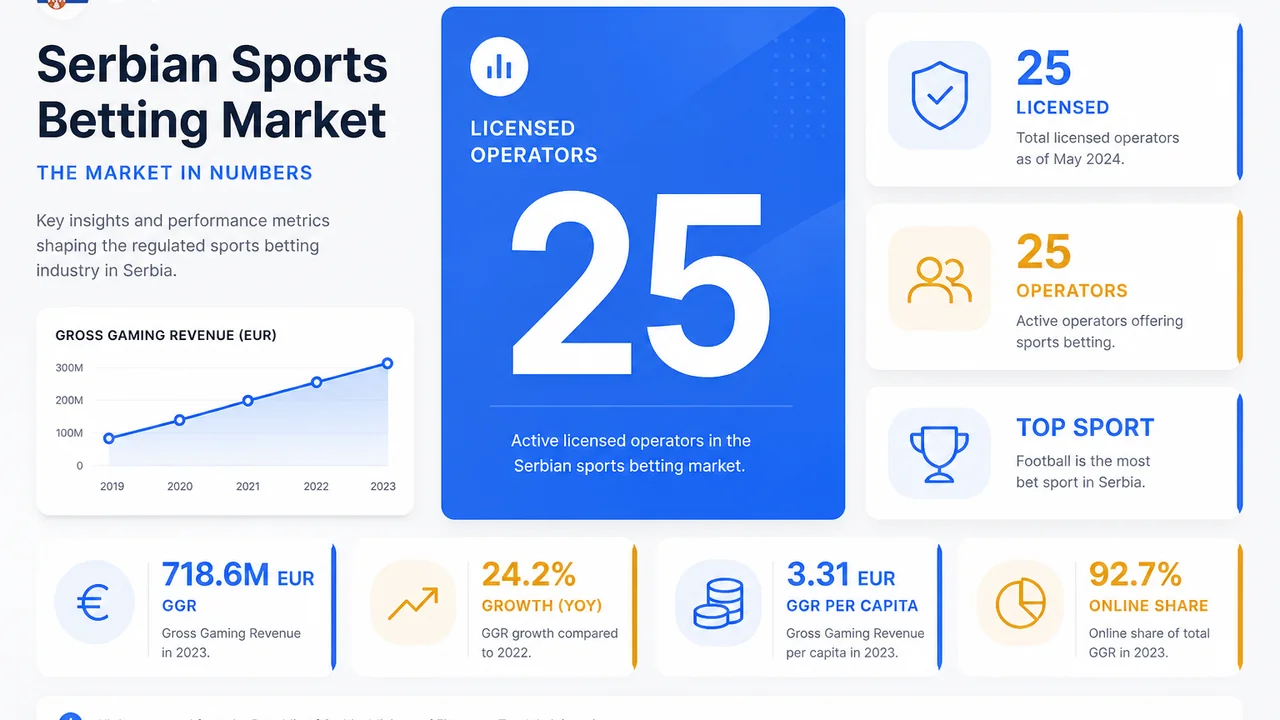
The Serbian sports betting market in numbers today has a specific shape that becomes clearer when you look at the regulated roster, the capital requirements, the tax rates, the integrity statistics and the wider European context all together. This long piece walks through the numbers that define the market as of late 2026, draws on publicly available information from the Serbian regulator, industry bodies and research summaries, and ends with the single number worth remembering if you only have time for one.
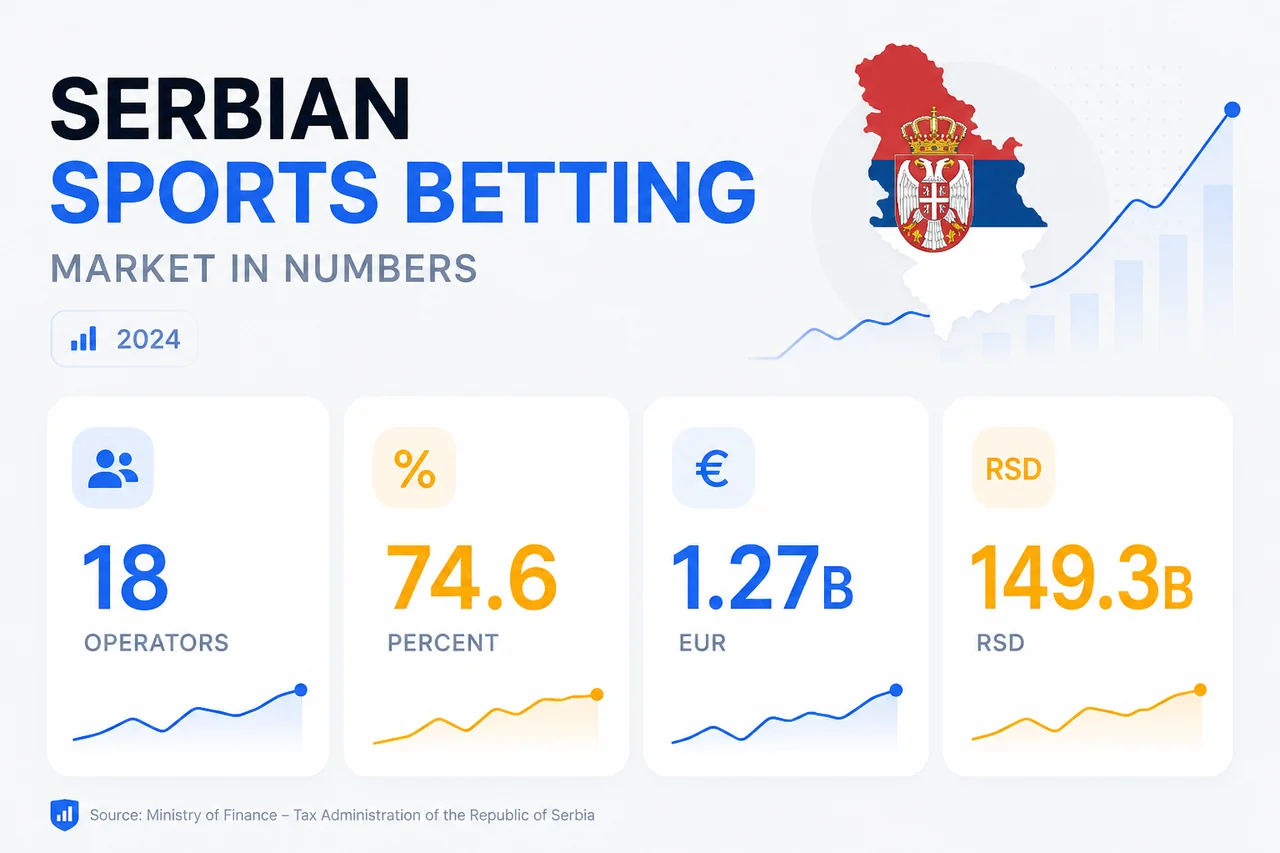
The point of running the market through numbers is not to produce a league table or a buyer’s guide. The point is to show the shape of the ecosystem the slip actually sits inside, so a Serbian player understands the scale of what they are participating in and where the practical edges live.
| Metric | Figure | Source and date |
|---|---|---|
| Licensed online operators | Around 25 as of October 2026 | Public register |
| Online betting GGR tax | 15 percent | 2020 Act, in force 2020 |
| Share capital for online licence | EUR 250,000 | 2020 Act |
| Bank deposit or guarantee | EUR 300,000 | 2020 Act |
| Player tax threshold | 100,000 RSD per single payout | Serbian income tax rules |
| Legal gambling age | 18 | Act on Games of Chance |
| EGBA EU online gambling GGR | About EUR 18 billion in 2025 | EGBA 2026 report |
| IBIA Q2 2026 suspicious alerts | 76 across nine sports | IBIA quarterly report |
The Licensed Roster Sits at About Twenty-Five Operators
The Serbian Games of Chance Administration under the Ministry of Finance maintains a public register of licensed online gambling operators. As of October 2026, the register listed around 25 online operators approved to accept Serbian players. This number is relatively stable; it moves by one or two across most years rather than by larger swings.
Observation. A small roster is a navigable roster, which is one of the quiet advantages of the Serbian market for players.
- Mozzart
- Meridianbet
- MaxBet
- Soccerbet
- AdmiralBet
- BalkanBet
Twenty-five operators is a small enough number that a Serbian player can memorise the top ten by name and recognise the rest by brand. The concentration of market share among the top operators is high, with Mozzart, Meridianbet, MaxBet, AdmiralBet, Soccerbet and BalkanBet capturing most of the visible attention in both land-based and online channels.
Why a Small Roster Matters for Players
A small roster matters because the comparison exercise is tractable. A Serbian player can realistically compare two or three operators on specific criteria in an evening. In larger markets with hundreds of licensed operators, the comparison is overwhelming and tends to default to whichever brand ran the most prominent recent advertising campaign.
The small roster also means the regulator can supervise effectively. Twenty-five operators is a number that the Games of Chance Administration can review in detail, which supports the quality of the real-time IT exchange that the 2020 Act requires non-casino operators to maintain.
The Capital Numbers Are Not Trivial
The capital numbers behind each licence are substantial. The share capital requirement for an online gambling licence is EUR 250,000. The bank deposit or guarantee lodged with the regulator is EUR 300,000. For a multi-licence operator holding both betting and online gambling approvals, the capital totals cumulate, which means a mid-sized Serbian operator carries meaningfully more than a million euros of regulatory capital behind player balances.
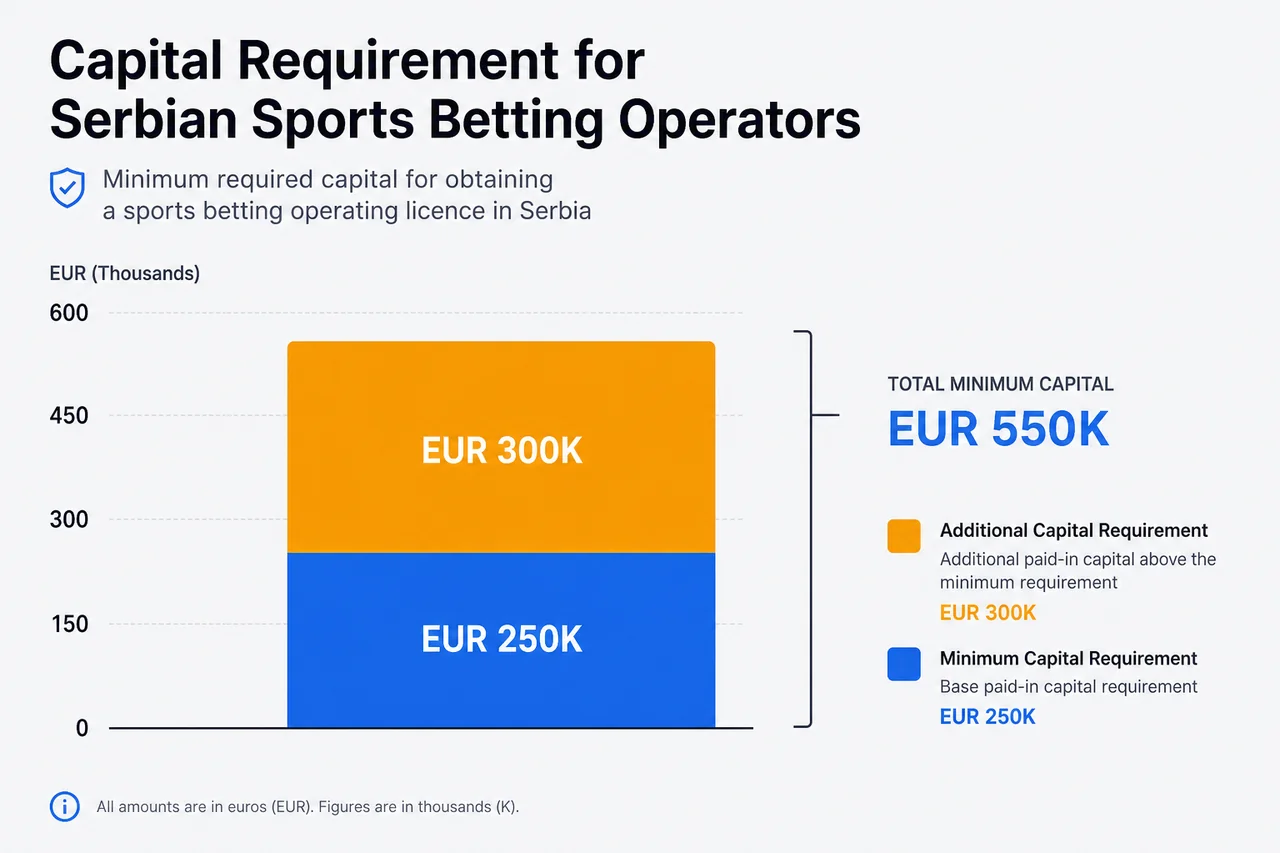
These numbers do not look large by multinational banking standards, but they are substantial relative to the operator’s annual revenue in a market the size of Serbia. The capital is a real constraint on who can hold a Serbian licence, which contributes to the stability of the licensed roster.
What Each Number Protects
The share capital is operational working capital. The bank deposit or guarantee is specifically a player-balance backstop that the regulator can access during an operator insolvency or compliance failure. Together, the numbers mean a Serbian licensed operator carries real financial accountability to its account holders, enforced through specific regulatory mechanisms.
The Tax Structure Has Two Sides
The Serbian tax structure around betting has two sides. On the operator side, online betting is taxed at 15 percent of gross gaming revenue, meaning the operator’s revenue after paying out winners. On the player side, winnings above 100,000 RSD on a single payout are subject to a 20 percent tax, with the threshold roughly 850 euros at a stable exchange rate.
These two tax layers are independent. The operator’s GGR tax does not come out of the player’s winnings directly; it is baked into the overround on each priced market. The player’s 20 percent charge applies only to single-payout events above the threshold, which is a relatively rare occurrence for casual weekly staking.
- Operator GGR tax: 15 percent on online betting
- Player tax threshold: 100,000 RSD per single payout
- Player tax rate above threshold: 20 percent
- Operator GGR tax on broadcast live games: 25 percent per SOFTSWISS regulatory map
Operator Fees Compound the Capital Numbers
On top of the capital requirements and the GGR tax, Serbian operators pay operational fees. Betting shops pay a minimum monthly fee of EUR 550 per shop. Online non-betting operations pay a minimum of EUR 10,000 per month. These fees are not revenue-based; they are flat floors that apply regardless of volume.
For a mid-sized Serbian operator with multiple betting shops and an online presence, the operational fees compound into a substantial annual commitment. This is another reason the licensed market is stable: the fixed costs of operating under the Serbian framework are high enough that only credible operators enter and remain.
The IBIA Numbers Place Serbia in the Wider Market
The International Betting Integrity Association reports quarterly on suspicious betting alerts across its member operators. In the second quarter of 2026, IBIA reported 76 suspicious alerts across nine sports. Football accounted for 25 alerts (33 percent), esports for 16 (21 percent), basketball for 10 (13 percent), tennis for 9 (12 percent), and other sports made up the remaining 16 (21 percent).
Reference. IBIA data provides the global context in which Serbian licensed operators participate.
- Over 90 member operators
- Over 200 betting brands covered
- 1.5 million sporting events monitored annually
- 300 billion US dollars of global betting turnover covered
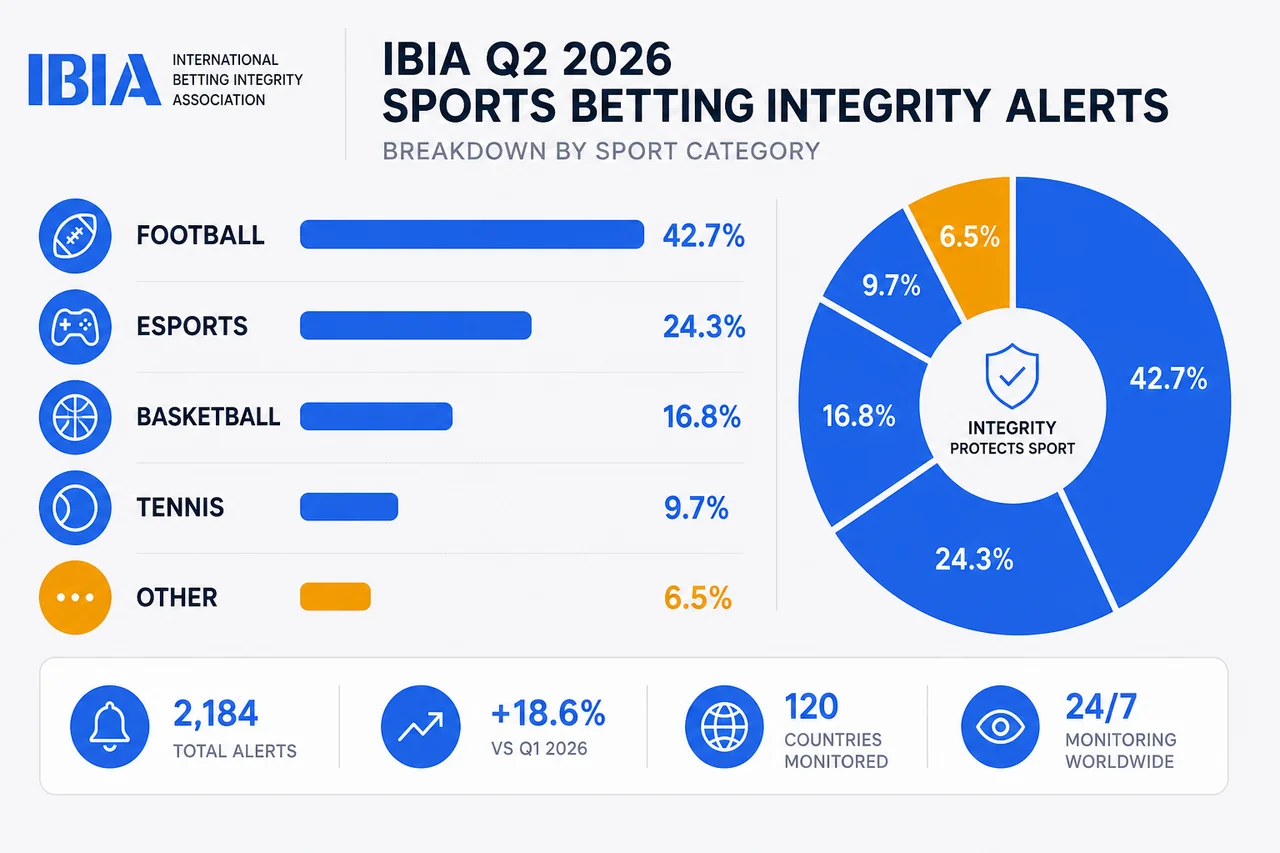
IBIA’s Global Monitoring and Alert Platform covers more than 90 member operators and more than 200 betting brands. The platform monitors more than 1.5 million sporting events per year and covers more than 300 billion US dollars of global betting turnover annually. For a Serbian player, these numbers represent the integrity work that quietly surrounds the licensed market.
Why the Alert Numbers Are Low
Seventy-six alerts across a quarter from a platform monitoring 1.5 million events per year is a very low rate. The number is not a measure of market cleanliness; it is a measure of the sophistication of the detection work and the strength of the integrity culture across member operators. The licensed Serbian market participates in this work through operator-level integrity teams and through the regulator’s coordination with international bodies.
The EGBA Numbers Give the European Context
The European Gaming and Betting Association’s 2026 annual report covered calendar year 2025. The report put EU online gambling gross gaming revenue at about EUR 18 billion for 2025, up from EUR 13.5 billion in 2024. Collective EU taxes paid by EGBA members totalled EUR 3.8 billion.
Note. The Serbian market sits inside a growing European ecosystem with substantial collective tax contributions.
Total stakes across EGBA members rose from 177.7 billion in 2024 to 248.7 billion in 2025. The average stake fell from EUR 1.21 in 2024 to EUR 1.11 in 2025, continuing a multi-year downward trend. The average return-to-player percentage was 93.4 percent in 2025, down from 93.7 percent in 2024.
| EGBA metric | 2024 | 2025 |
|---|---|---|
| EU online GGR | EUR 13.5 billion | About EUR 18 billion |
| Total stakes | 177.7 billion | 248.7 billion |
| Average stake | EUR 1.21 | EUR 1.11 |
| Average RTP | 93.7 percent | 93.4 percent |
How the Serbian Market Sits Inside Europe
The Serbian market sits inside this European ecosystem as a mid-sized national market with a tight licensing framework. The 15 percent operator GGR tax is in the lower middle of European rates; the player tax threshold at 100,000 RSD is modest by European standards; the capital requirements are consistent with other mid-sized markets.
What distinguishes the Serbian market is the small, stable roster, the clear regulatory structure, and the real-time IT exchange that gives the regulator substantial visibility into operator ledgers. These are not unique to Serbia but they combine into a notably supervised market by regional standards.
The SPIS Numbers Are Behavioural
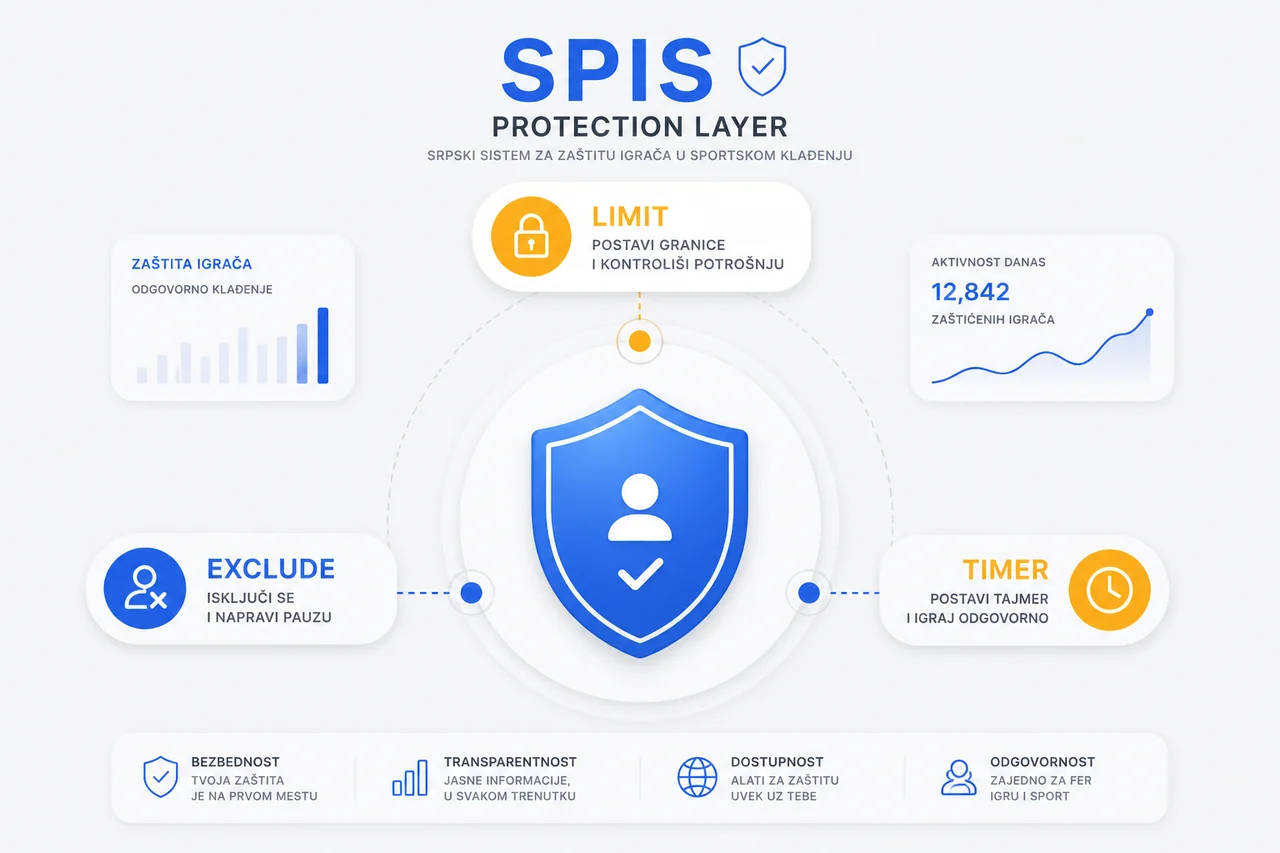
SPIS, the industry player protection body launched in Belgrade, operates on a different kind of number than the capital and tax metrics. Its “Even One Is Too Many” campaign works with the Special Hospital for Addiction Diseases in Belgrade to educate teenagers in sports clubs, a prevention measure rather than a market-sizing one.
The SPIS numbers that matter are the counts of self-exclusions registered through the centralised system and the number of operators participating. These are not published publicly in detail, but the regulatory framework ensures the data exchange is comprehensive across member operators. For a Serbian player, this means a self-exclusion registered through SPIS carries weight across the whole licensed market.
The Payment Numbers Are Fast
Payment numbers in Serbia have improved dramatically over the last decade. IPS Instant Payment System clears in seconds in both directions. Card deposits are usually immediate. Serbian bank transfers settle in business hours. Withdrawals to IPS or cards usually arrive within hours or a day or two, depending on the method and the operator.
These numbers compare favourably to European averages. The practical result for a Serbian player is that the account cycle, from deposit through settlement through withdrawal, runs faster than it did a decade ago. The friction that used to characterise the hobby’s money side has largely disappeared on the licensed market.
The Research Numbers Shape the Rules
Research numbers from GambleAware and from in-play betting studies summarised in The Conversation have shaped how Serbian regulators and operators approach responsible-play tools. The behavioural work on anchoring and commitment devices, the research on tilting and instant deposit features, and the broader prevalence studies on problem gambling in Europe inform the design of the toolkit the January 2025 amendments made more visible in Serbian account menus.
The specific numbers vary by study and population, but the pattern is consistent. Pre-set limits reduce loss chasing. Session timers reduce overlong sessions. Cool-off windows reduce impulse raises. The Serbian framework incorporates all three because the research consistently supports their effectiveness.
Why Research Translates Into Regulation Here
Research translates into regulation in Serbia because the regulatory framework is relatively young and still being refined. The 2020 Act and its 2024 amendments both incorporated findings from the European research base, which produces a framework that is more current than markets with older entrenched regulations. For a Serbian player, this means the responsible-play tools in the account menu reflect behavioural best practice as understood in the mid-2020s.
The Guide Numbers Help Navigation
A Serbian guide such as www.burazbet.com is a good thing for a Serbian player because it collapses the numbers above into a navigable interface. The guide covers only operators on the Games of Chance Administration register, lists their current promotions, notes their payment options, and keeps the comparison exercise inside the regulated market. For most casual players, this collapses what would be hours of comparison into a reading step before the account form opens.
The guide’s own numbers matter less than its editorial discipline. A guide that stays inside the licensed roster, publishes updates when operators change their terms, and acknowledges where its coverage is thin earns a different kind of trust than one that promises exhaustive coverage of every operator globally.
The Overall Shape of the Market in One View
Pulling all the numbers together, the Serbian sports betting market in late 2026 is a mid-sized, tightly regulated national market with about twenty-five licensed online operators, each backed by hundreds of thousands of euros of regulatory capital, operating under a 15 percent GGR tax that funds a 20 percent player-side tax on substantial single payouts, overseen by a well-resourced regulator with real-time ledger visibility, participating in European integrity work through IBIA, and sitting inside a wider EU online gambling market of about EUR 18 billion in annual gross gaming revenue.
That is the ecosystem the Serbian slip actually sits inside. The scale and the structure both matter. The scale means the market is small enough to be navigable; the structure means it is supervised enough to be trustworthy. Together, these two features make the licensed Serbian market one of the more comfortable corners of European online betting for a casual player.
The Single Number Worth Remembering
If only one number is worth remembering, it is the 25 licensed online operators on the Serbian register. Every decision a player makes about where to open an account should start from this number. An unlicensed operator may offer a more aggressive welcome bonus; it will not sit inside the capital, the IT exchange, the KYC rules, the self-exclusion register or the dispute path that make the licensed market the sensible place to run the hobby.
Takeaway. Every operator decision should start from the twenty-five on the Serbian register.
- Verify the operator is on the register
- Read the terms before signup
- Set the deposit limit before the first deposit
- Keep the account inside the licensed market
The Serbian sports betting market in numbers today is ultimately a market of 25 operators, each with its own strengths and weaknesses, all sitting inside a shared regulatory structure that makes the hobby sustainable for the casual Serbian player willing to pick one and stay with it across a season.
Where to Go From the Numbers
The numbers are a starting point. The decision framework for picking a specific operator, the behavioural science for running the account well, the glossary for reading the slip, the field report for understanding the local context, and the twenty-year history for understanding how the market arrived here all build on the numbers above. The hobby is quantitative at its base and qualitative in its texture, and both sides reward attention over the course of a Serbian season.
Numbers are a map. The map is useful. The territory is still the player’s own weekend, repeated across a year, inside a licensed framework that counts in hundreds of thousands of euros of capital so that the slip you place at seventeen past three on a Saturday afternoon settles cleanly when the full-time whistle blows.